

Soins infirmiers auxiliaires autorisés / Licensed Practical Nursing
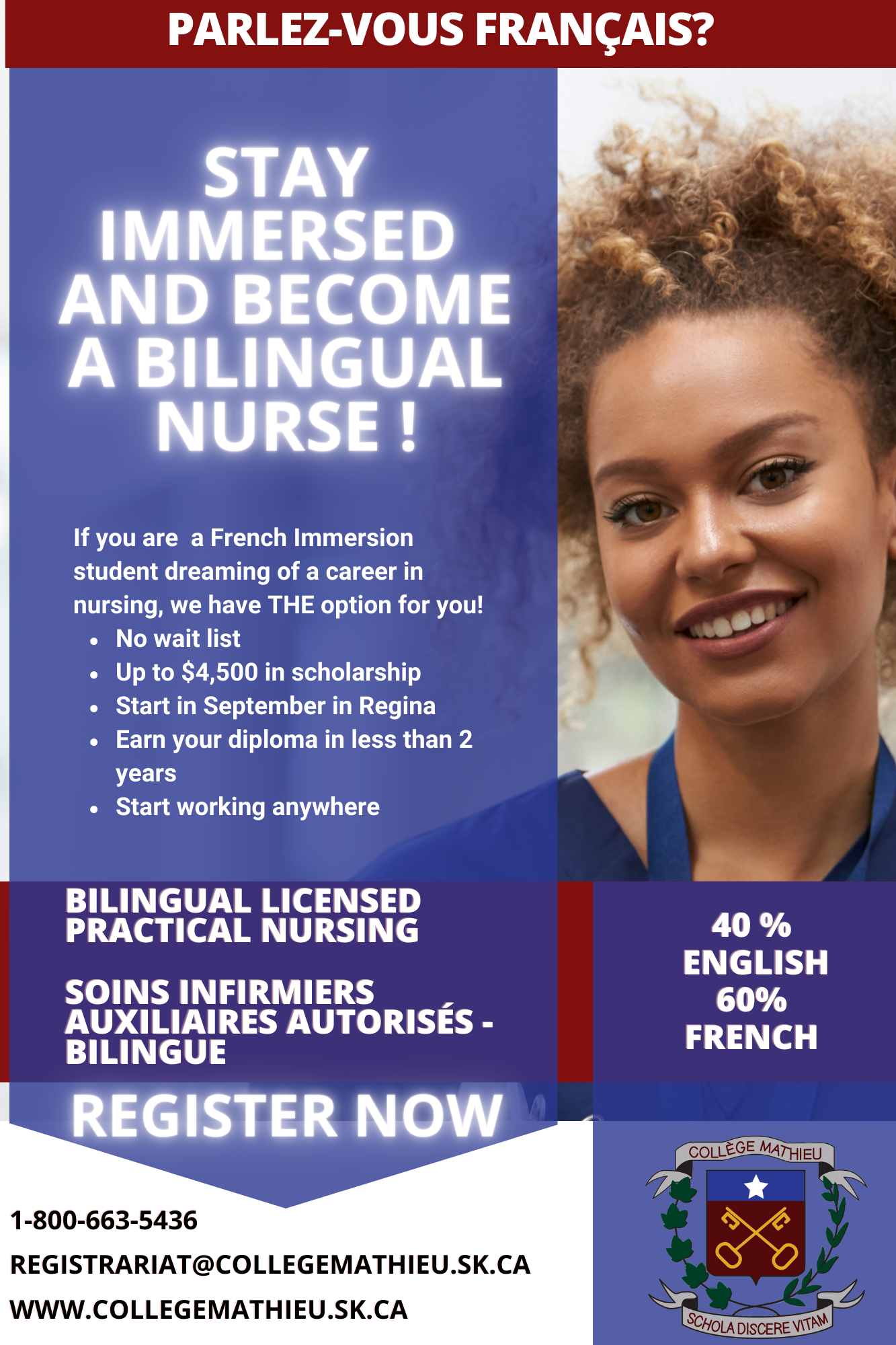
Programme d’infirmière auxiliaire autorisée bilingue – Collège Mathieu
Le programme d’infirmière auxiliaire autorisée bilingue du Collège Mathieu offre une formation unique destinée aux étudiants souhaitant évoluer dans des milieux de soins où le bilinguisme est un atout. L’enseignement est offert à 60 % en français et à 40 % en anglais, permettant aux diplômés d’être pleinement préparés aux réalités du milieu de la santé.
- 3 bourses de 10 000 $
Accordées aux trois premiers diplômés issus des écoles du CEF (Conseil des écoles fransaskoises). - 5 bourses de 1 500 $
Accordées aux cinq premiers étudiants inscrits au programme. - 3 bourses de 1 500 $
Accordées aux diplômés issus de l’immersion française.
Les étudiants admissibles peuvent recevoir plus d’une bourse, lorsque applicable.
⚠️ Veuillez noter que ces bourses ne s’appliquent pas aux étudiants internationaux.
Bilingual Licensed Practical Nursing Program – Collège Mathieu
The Bilingual Licensed Practical Nursing Program at Collège Mathieu offers a unique training experience designed for students who wish to work in healthcare environments where bilingualism is an asset. The program is delivered in a 60% French and 40% English learning environment, preparing graduates to succeed in diverse clinical settings.
? Scholarships available
- 3 scholarships of $10,000
Awarded to the first three graduates from CEF (Conseil des écoles fransaskoises) schools. - 5 scholarships of $1,500
Awarded to the first five students to register in the program. - 3 scholarships of $1,500
Awarded to graduates from French immersion programs.
Eligible students may receive more than one scholarship where applicable.
⚠️ Please note that these scholarships do not apply to international students.


Programme bilingue - Bilingual program
Ce programme est offert 60% en français et 40% en anglais - This program is offered 60% in French with the remaining 40% in English
Le programme bilingue de soins infirmiers auxiliaires, offert conjointement par le Collège Mathieu et Saskatchewan Polytechnic permet aux étudiants d’acquérir des connaissances et de développer des compétences théoriques et cliniques nécessaires au bien-être de la personne ayant besoin de santé. Les infirmières et infirmiers auxiliaires autorisés sont des professionnels de la santé qui travaillent en étroite collaboration avec une équipe multidisciplinaire de soins de santé. Ils contribuent à la dispensation des soins infirmiers professionnels pleins de compassion aux personnes de différents âges de la vie humaine, des nourrissons aux personnes âgées, dans des contextes hospitaliers, ambulatoires et de prévention.
***
Our bilingual practical nursing program, offered as the result of a collaboration with Saskatchewan Polytechnic, allows students to acquire knowledge and develop theoretical and clinical skills necessary for tending to the well-being of the person in need of health. Licensed practical nurses are health professionals who work closely with a multidisciplinary health care team. They help provide compassionate professional nursing care to people of all ages.
Le diplômé aura les compétences pour :
- Répondre aux besoins fondamentaux des patients (leur donner un bain, les aider à s’habiller, les aider à se nourrir, etc.);
- Établir une relation de confiance avec les patients, leurs familles, ainsi que les autres membres de l’équipe de santé;
- Contribuer à l’évaluation de l’état de santé du patient et à la réalisation de son plan de soins;
- Mesurer les signes vitaux (tension, pouls, respiration...);
- Distribuer et administrer certains médicaments selon la prescription médicale (notamment les médicaments par voie orale);
- Effectuer des prélèvements sanguins;
- Surveiller et évaluer l’état de santé de patients et informer l’équipe soignante des changements dans leurs conditions;
- Effectuer la vaccination de diverses clientèles;
- Assister à d’autres interventions infirmières tout en exerçant sa fonction comme infirmière auxiliaire.
Le diplômé de ce programme sera en mesure de fournir des soins infirmiers auxiliaires de qualité, quelle que soit la personne soignée et/ou le milieu du pratiquant exerçant, à savoir les services de santé hospitaliers et les centres communautaires.
The graduate will have the skills to:
- Meet the basic needs of patients (give them a bath, help them get dressed, help them eat, etc.);
- Establish a relationship of trust with patients, their families, as well as other members of the health team;
- Contribute to the assessment of the patient's state of health and the completion of his care plan;
- Measure vital signs (blood pressure, pulse, breathing, etc.);
- Distribute and administer certain medications as prescribed (especially oral medications);
- Take blood samples;
- Monitor and assess the state of health of patients and inform the healthcare team of changes in their conditions;
- Perform the vaccination of various clienteles;
- Attend other nursing interventions while performing her duties as a nursing assistant.
The graduate of this program will be able to provide quality auxiliary nursing care, regardless of the person being treated and/or the practicing practitioner's environment, namely hospital health services and community centers.
Diplôme - Diploma
Nombre de crédits / Credits : 122
Durée (temps plein) / Length : 20 mois (months)
Composition / Program structure : 23 cours théoriques (23 theory courses) + 180 heures de laboratoire (lab) + 815 heures cliniques (clinical – stages/practicum)
Mode de livraison / Delivery mode : Hybride (en ligne et en présentiel), au laboratoire du campus de Regina/Hybrid (online and in-person), in the laboratory at the Regina campus.
Frais / Cost : admission 205 $ (non remboursable / non-refundable) + scolarité / tuition : 1re année 13 558 $ + 2e année 9 038 $ (livres inclus / books included) – total des deux années : 22 595,50
*Les frais de scolarité (livres inclus) sont pour le programme en entier. Tuition cost include books and cover the entire program.
Conditions d'admission - Admission requirements
En plus des conditions d'admission générales, les conditions spécifiques suivantes s'appliquent:
-
Fournir une preuve de citoyenneté canadienne ou de résidence permanente. D’autres statuts peuvent être considérés. Veuillez communiquer avec la coordinatrice des programmes en santé afin d’obtenir davantage de renseignements;
-
Fournir un extrait de casier judiciaire à jour, comprenant une vérification du secteur vulnérable;
-
Participer à une entrevue avec la coordinatrice du programme;
-
Détenir un diplôme d’études secondaires de 12e année, complété ou en voie d’obtention, avoir le statut d’étudiant adulte ou posséder un diplôme équivalent, avec une moyenne minimale de 65 % dans les matières suivantes :
-
Anglais A30 ou Anglais B30;
-
Mathématiques 30, Précalcul 30 ou Mathématiques du milieu de travail et de l’apprentissage 30;
-
Biologie 30, Chimie 30 ou Physique 30;
-
Études sociales 30, Histoire 30 ou Études autochtones 30.
La personne candidate est admissible si la moyenne générale obtenue dans les matières exigées est égale ou supérieure à 65 %.
-
-
Fournir une preuve de compétence linguistique en anglais ou en français :
Anglais – IELTS académique :
-
Compréhension orale (Listening) : 7,0;
-
Compréhension écrite (Reading) : 6,5;
-
Expression écrite (Writing) : 6,5;
-
Expression orale (Speaking) : 7,0;
-
Résultat global : 7,0.
Français – TEF :
-
Compréhension écrite : niveau 4 (B2);
-
Compréhension orale : niveau 4 (B2);
-
Expression écrite : niveau 4 (B2);
-
Expression orale : niveau 5 (C1).
-
-
Être en mesure de satisfaire à toutes les exigences liées à l’exercice de la profession, notamment les exigences physiques associées au déplacement et au repositionnement des patients, aux longues périodes de travail en position debout ainsi qu’aux exigences émotionnelles liées aux situations stressantes ou urgentes;
-
Fournir, avant le début du stage clinique, un dossier d’immunisation à jour répondant aux exigences du Collège Mathieu, notamment :
-
la vaccination contre l’hépatite B, dont la première dose doit être administrée au moins deux mois avant le début des cours;
-
un test cutané à la tuberculine en deux étapes, également appelé test de Mantoux;
-
-
Fournir une preuve valide d’ajustement d’un masque respiratoire N95 avant l’admission au stage clinique;
-
Fournir une preuve de certification en transfert, levage et repositionnement sécuritaires (TLR);
-
Fournir une preuve de certification valide en premiers soins et RCR de niveau C avec DEA, ou une certification équivalente, avant le début du stage clinique.
***
In addition to the general admission requirements, the following specific conditions apply:
-
Provide proof of Canadian citizenship or permanent resident status. Applicants with other immigration statuses may also be considered. Please contact the Health Programs Coordinator for further information;
-
Provide a valid criminal record check, including a vulnerable sector check;
-
Participate in an interview with the Program Coordinator;
-
Hold a completed or in-progress Grade 12 high school diploma, have mature student status, or possess an equivalent qualification, with a minimum average of 65% in the following subjects:
-
English A30 or English B30;
-
Mathematics 30, Pre-Calculus 30, or Workplace and Apprenticeship Mathematics 30;
-
Biology 30, Chemistry 30, or Physics 30;
-
Social Studies 30, History 30, or Indigenous Studies 30.
Applicants are eligible if their overall average in the required subjects is 65% or higher.
-
-
Provide proof of proficiency in English or French:
English – IELTS Academic:
-
Listening: 7.0;
-
Reading: 6.5;
-
Writing: 6.5;
-
Speaking: 7.0;
-
Overall score: 7.0.
French – TEF :
-
Reading comprehension: Level 4 (B2);
-
Listening comprehension: Level 4 (B2);
-
Written expression: Level 4 (B2);
-
Oral expression: Level 5 (C1).
-
-
Be able to meet all occupational requirements, including the physical demands associated with transferring and repositioning patients, working long hours while standing, and managing the emotional demands of stressful and emergency situations;
-
Provide an up-to-date immunization record that meets Collège Mathieu’s requirements before beginning the clinical placement, including:
-
hepatitis B vaccination, with the first dose administered at least two months before the start of classes;
-
a two-step tuberculin skin test (TST), also known as the Mantoux test;
-
-
Provide valid proof of N95 respirator fit testing before admission to the clinical placement;
-
Provide proof of certification in safe patient transfer, lifting, and repositioning (TLR®);
-
Provide proof of valid certification in First Aid and CPR Level C with AED, or an equivalent certification, before beginning the clinical placement.
Dates importantes - Important dates
Admission et Inscription pour l'année académique 2026-2027
Prochaine session automne 2027 merci de nous contacter : admissions@collegemathieu.sk.ca
Jusqu'au 15 août - Until August 15
Les dates sont susceptibles de changer, veuillez consulter régulièrement cette page.
Dates are subject to change, consult this page regularly.
Dates des sessions - Année académique 2026-2027
AUTOMNE 2026
Début des cours : 8 septembre 2026
Fin des cours : 30 juin 2028
Liste des cours - Course list
Année 1 - Session Automne Sept - Dec
- BIOL 102 - Anatomy and Physiology 1
- CLIN 103 - Health Assessment and Praxis 1
- NURG 118 - Professional Practice and Communication 1
- NURS 171 - Foundations 1 - Foundations of Health
- NURS 172 - Variations in Health 1
Année 1 - Session Hiver Jan - Avr
- BIOL 103 - Human Anatomy and Physiology 2
- CLIN 104 - Health Assessment and Praxis 2
- NURS 293 - Variations in Health 2
- PHAR 109 - Pharmacology 1
- PHAR 110 - Pharmacology 2
Année 1 - Session Printemps Mai-Jun
- CLIN 105 - Integrated Clinical Practice 1
- SOCI 171 - Foundation of Sociology
Année 2 - Session Automne Sept - Dec
- CLIN 240 - Health Assessment and Praxis 3
- NRSE 206 - Professional practice and communication 2
- NURS 177 - Foundation 2 - Mental Health and Substance Use Desorders
- NURS 294 - Variations in Health 3
Année 2 - Session Hiver Jan - Avr
- CLIN 241 - Health Assessment and Praxis 4
- NURS 292 - Foundations 3 - Maternal Child Health
- NRSG 298 - Foundations 4 Community Health
- NRSG 299 - Variations in Health 4
- SOCI 203 - Indigenous Health, Wellness, and the Creation of Culturally Safe Health care
Année 2 - Session Printemps Mai - Juin
- CLIN 242 - Integrated Clinical Practice 2
- BIOL 102 - Human Anatomy and Physiology 1 (3 credits)
45 hrs Theory - CLIN 103 - Health Assessment and Praxis 1 (10 credits)
29 hrs Theory + 80 hrs Clinical + 41 hrs Lab/Seminar = 150 hrs - NURS 163 - Professional Practice and Communication 1 (3 credits)
24 hrs Theory + 21 hrs Lab/Seminar = 45 hrs - NURS 171 - Foundations 1 - Foundations of Health (3 credits)
45 hrs Theory - NURS 172 - Variations in Health 1 (3 credits)
45 hrs Theory - PHAR 101 - Pharmacology 1 (3 credits)
45 hrs Theory
Semester Total (25 credits)
233 hrs Theory + 80 hrs Clinical + 62 hrs Lab/Seminar = 375 hrs Total
- BIOL 103 - Human Anatomy and Physiology 2 (3 credits)
45 hrs Theory - CLIN 104 - Health Assessment and Praxis 2 (9 credits)
25 hrs Theory + 80 hrs Clinical + 30 hrs Lab/Seminar = 135 hrs - NURS 176 - Foundations 2 - Mental Health (3 credits)
45 hrs Theory - NURS 240 - Professional Practice and Communication 2 (3 credits)
19 hrs Theory + 26 hrs Lab/Seminar = 45 hrs - NURS 293 - Variations in Health 2 (3 credits)
45 hrs Theory - PHAR 102 - Pharmacology 2 (4 credits)
45 hrs Theory + 15 hrs Lab/Seminar = 60 hrs
Semester Total (25 credits)
224 hrs Theory + 80 hrs Clinical + 71 hrs Lab/Seminar = 375 hrs Total
- CLIN 105 - Integrated Clinical Practice 1 (8 credits)
120 hrs Clinical - SOCI 160 - Foundations of Sociology (3 credits)
45 hrs Theory
Semester Total (11 credits)
45 hrs Theory + 120 hrs Clinical = 165 hrs Total
- CLIN 240 - Health Assessment and Praxis 3 (13 credits)
15 hrs Theory + 160 hrs Clinical + 20 hrs Lab/Seminar = 195 hrs - NRSG 257 - Professional Practice and Communication 3 (3 credits)
45 hrs Theory - NURS 294 - Variations in Health 3 (3 credits)
45 hrs Theory - NSRG 258 - Addictions (3 credits)
45 hrs Theory - SOCI 201 - Culture and Diversity in Health Sciences (3 credits)
45 hrs Theory
Semester Total (25 credits)
195 hrs Theory + 160 hrs Clinical + 20 hrs Lab/Seminar = 375 hrs Total
- CLIN 241 - Health Assessment and Praxis 4 (15 credits)
15 hrs Theory + 135 hrs Clinical + 15 hrs Lab/Seminar = 225 hrs - NURS 292 - Foundations 3 - Maternal Child Health (3 credits)
45 hrs Theory - NSRG 298 - Foundations 4 - Community Health (3 credits)
45 hrs Theory - NSRG 299 - Professional Practice and Communication 1 (3 credits)
25 hrs Theory + 20 hrs Clinical = 45 hrs - PHAR 215 - Pharmacology 3 (2 credits)
20 hrs Theory + 10 hrs Lab/Seminar = 30 hrs
Semester Total (25 credits)
135 hrs Theory + 215 hrs Clinical + 25 hrs Lab/Seminar = 375 hrs Total
- CLIN 242 - Integrated Clinical Practice 2 (11 credits)
165 hrs Clinical
Semester Total (11 credits)
165 hrs Clinical
Admissions
Portail d'admission en ligne
Accédez au portail pour créér votre compte et soumettre votre demande d'admission.

Soyez informé! Be informed!
Ce programme est offert en partenariat avec Saskatchewan Polytechnic et la contribution du Consortium national de formation en santé.